
The sky over Los Angeles went black in midafternoon, and most people had no idea that the real danger was not the flames, but what you could not see in that smoke.
Story Snapshot
- A Lineage cold-storage warehouse roof fire in Boyle Heights sent a huge toxic-looking plume over Los Angeles and forced thousands to shelter inside their homes.
- The blaze chewed through rooftop solar panels and compromised an ammonia refrigeration line, triggering hazmat alarms and hard questions about “green” tech on massive industrial buildings.
- Officials first warned of hazardous materials and unhealthy air, then later downplayed the risk, feeding public distrust and online conspiracy chatter.
- The fire fits a growing pattern: big cold-storage facilities mixing solar, chemicals, and dense cities, while regulators and companies insist everything is “under control.”
A midafternoon fire that turned day into night
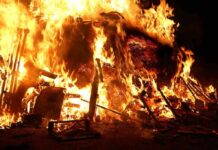
Just after 2:30 p.m., a fire erupted on the roof of a nearly 500,000-square-foot Lineage cold-storage warehouse in Boyle Heights, east of downtown Los Angeles.[1] Flames raced across rows of rooftop solar panels, and within minutes a thick black column of smoke towered over the freeways and skyline.[1][2] Local television helicopters captured the scene in real time: firefighters on ladders, water cannons straining, a roof that looked more like a burning hillside than a flat building.[3]
People miles away snapped photos and rushed them onto social media, calling it an “urban wildfire in the sky.” Drivers watched from clogged freeways as the plume drifted across the city. For residents in working-class blocks below, it was not a spectacle. It was a question with no clear answer yet: what exactly are we breathing right now?
Shelter-in-place orders and a city told to seal itself shut
The Los Angeles Fire Department did not take chances. Officials pushed a shelter-in-place order that stretched from near the 101 Freeway down to Washington Boulevard, and from Soto Street east toward Indiana.[1] The message to phones and television crawls was blunt: get inside, shut all windows and doors, turn off your air conditioning, bring pets indoors, and wait for further instructions.[1][6] That kind of language is usually reserved for chemical incidents, not simple structure fires.
The reason sat inside the building’s walls. This warehouse, like many cold-storage facilities, relied on anhydrous ammonia for large-scale refrigeration.[4][23] That chemical is efficient and common, but it can burn lungs, eyes, and skin, and can become explosive at high concentrations.[24] As firefighters attacked the blaze, an ammonia line was compromised. Pressurized gas began to off-gas into the fire zone, forcing crews off the roof and out of the interior.[4][9] The operation shifted from offense to defense as helicopters dumped water from above.[1][4]
Toxic smoke, reassurances, and mixed messaging
From the street, the picture was simple: a black plume big enough to darken the afternoon, reports of ammonia, and orders to stay inside. Many residents heard “toxic” long before they heard “contained.” National and international outlets repeated phrases like “toxic smoke” and “hazardous air,” amplifying the sense that Los Angeles was under some kind of industrial cloud.[2][3] At the same time, fire officials stressed that the greatest danger was close to the building, not citywide.
Los Angeles Fire Department leaders later explained that, based on monitoring downwind, the smoke and ammonia were not expected to be dangerous to the general public unless someone had a respiratory condition or came into direct contact with the gas.[9][10] The ammonia threat, one department spokesperson said, had “dissipated” by late afternoon, even as a broader air quality advisory stayed in place east of downtown and into the San Gabriel Valley until the next morning.[1][6] That shift—from urgent sealed homes to technical reassurances—left many residents asking which version to trust.
What the fire really shows about modern warehouses
This was not just a random warehouse blaze; it was a perfect snapshot of how modern city infrastructure stacks risk. Start with a half-million-square-foot industrial box filled with temperature-controlled goods for a global supply chain.[1][13] Add a rooftop carpet of solar panels feeding power back into the system or the grid.[2][8] Run large ammonia refrigeration lines through that complex. Then drop it all next to a major freeway and dense neighborhoods.
When something goes wrong in that setup, officials have only minutes to choose between underreacting and overreacting. From a common-sense, conservative view, you protect people first and sort out the nuance later. That is what the shelter order did. But the real question is upstream: why do we keep learning about the risks of these systems only after something blows, leaks, or burns? Investigations in other cold-storage ammonia incidents have already shown that weak maintenance, poor training, and safety shortcuts make leaks far more likely.[20][22]
Policy, accountability, and what comes next
Regulators already treat anhydrous ammonia as a high-risk chemical, with strict rules for ventilation, emergency plans, and worst-case scenarios.[24] Yet fires and leaks keep happening in this industry, often with the same themes: workers evacuated, neighborhoods told to shelter, and public statements that everything is “within acceptable limits.”[19][21][25] Meanwhile, residents who live under these plumes rarely get a say in how much risk gets built on their block.
Gemini today,
…
A massive commercial cold storage warehouse fire that broke out on South Los Palos Street in Boyle Heights has been knocked down. The fire released an ammonia leak and a thick plume of smoke, leading to shelter-in-place orders. Localized fumes and smoke are…— Real Leslie Lesh (@realLeslieLesh) June 18, 2026
Many online voices jumped straight to arson or sabotage theories, including claims that workers burned warehouses after pay disputes.[16][17] So far, there is no public evidence that the Boyle Heights fire was anything other than an industrial accident; the cause remains under investigation.[1][11] The more grounded concern is different: if we keep packing solar, chemicals, and massive inventories into single buildings in crowded cities, how many more times will people be told to “stay inside and hope the monitors are right?” That is the conversation Los Angeles cannot afford to smother under the next black cloud.
Sources:
[1] YouTube – Los Angeles warehouse fire engulfs the city in toxic smoke
[2] Web – Massive fire at warehouse in Boyle Heights triggers shelter-in-place …
[3] Web – Shelter-in-place lifted after large fire at Boyle Heights cold storage …
[4] Web – Los Angeles Warehouse Fire Prompts Thousands to Shelter in Place
[6] Web – Crews have contained a fire at a Boyle Heights cold storage facility …
[8] Web – Thick black smoke and flames are erupting from a solar … – Instagram
[9] Web – BOYLE HEIGHTS: A fire erupted in a cold storage facility … – …
[10] Web – Here’s what we know about Lineage, the company behind the cold …
[11] Web – Toxic smoke engulfs Los Angeles as massive warehouse fire sparks …
[13] Web – Massive warehouse inferno sends toxic smoke over Los Angeles
[16] Web – Firefighters are battling an explosive fire that broke out at a …
[17] YouTube – L.A. Warehouse REFUSES Raises… Then Workers TORCH THE PLACE
[19] Web – What we know about Lineage storage facility
[20] Web – Ammonia leak prompts hazmat response at Delano cold storage …
[21] Web – How to Detect and Avoid Ammonia Leaks – MDC Systems
[22] YouTube – Ammonia leak prompts hazmat response at Delano cold …
[23] Web – Millard Refrigerated Services Ammonia Release – CSB
[24] Web – Ammonia Refrigeration in Warehouses
[25] Web – Protect Against the Hazards of Cold Storage – Environmental Risks …
© targetliberty.org 2026. All rights reserved.