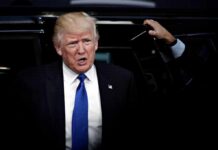

What separates a heckler from a headline is almost always the speaker’s response, and few American politicians have turned that split-second choice into as durable a piece of political theater as President Trump.
Key Points
- President Trump was interrupted by protesters during an August 21 rally in Myrtle Beach, South Carolina, held to support Darline Graham’s Senate campaign
- Security and convention center staff removed the disrupters, including one wearing a shirt with a violent slogan aimed at accused sex offenders
- Trump briefly paused, delivered a dismissive line about the protester’s mother, and resumed his remarks without missing a beat
- The episode fits a decade-long pattern of rally disruptions that has repeatedly become entangled with First Amendment litigation over crowd removal
- Legal scholars trace the underlying tension to the doctrine of the “heckler’s veto,” a concept far older than any single campaign
What Happened at the Myrtle Beach Convention Center
The rally itself was unremarkable in its purpose: President Trump traveled to Myrtle Beach to campaign for Darline Graham, a political newcomer contesting the U.S. Senate seat left vacant by her late brother, in a race widely read as an early test of the administration’s pull heading into the November midterms. The Myrtle Beach Convention Center was packed, the crowd receptive, and the speech proceeding along familiar lines until at least two protesters made themselves known partway through — one shouting toward the stage, another holding a shirt bearing a violent slogan directed at accused pedophiles, paired with a hat bearing an inverted American flag, a symbol some protest movements use to signal distress.
Security and convention staff moved quickly. According to the White House pool report, the disruptive individuals were escorted out with minimal delay, a routine outcome at large political events where organizers train staff specifically for this contingency. The mechanics were unremarkable: a raised voice, a visible shirt, a walk to the exit flanked by uniformed personnel. What made the moment notable wasn’t the disruption itself but what the president did with it.
The Line, and Why It Landed
Trump did not ignore the interruption, nor did he let it derail his remarks for more than a few seconds. He told the departing protester that they would be “going home to mom” and would “get scolded” because, as he put it, their mother was voting for him — a line calibrated less to wound than to entertain, drawing an immediate roar of approval from the friendly crowd. One account of the moment even describes Trump briefly pausing beforehand, uncertain whether the audience reaction he heard was praise or protest, before recovering his footing and delivering the retort. That small hesitation is itself instructive: even a practiced performer needs a beat to read a room before turning a disruption into a punchline.
This is not incidental showmanship. Over nine campaign cycles’ worth of rallies, Trump has built a recognizable repertoire for handling hecklers — mockery, dismissal, occasionally a call to security, rarely a substantive engagement with whatever grievance prompted the interruption. The approach works because it is fast, because it flatters the assembled crowd at the heckler’s expense, and because it converts a moment of friction into a moment of shared laughter. Political consultants have a term for this kind of exchange: a “controlled disruption,” one that reinforces rather than undermines the speaker’s command of the room.
A Recurring Feature, Not an Aberration
Rally heckling has trailed Trump’s political career since its earliest days. Protesters were forcibly removed from a Las Vegas rally in December 2015, well before he secured the Republican nomination, in scenes that drew supporter jeers nearly identical to those in Myrtle Beach a decade later. What distinguishes the more recent episodes is not their frequency but their afterlife: incidents from the 2016 campaign, including a Louisville, Kentucky rally where Trump told supporters to “get ’em out of here,” generated years of federal litigation over whether his rhetoric had incited the physical removal that followed. The Sixth Circuit ultimately ruled that his instruction was protected campaign speech, not incitement, closing off one avenue protesters had used to hold the campaign legally accountable for audience conduct.
That legal backdrop matters because it explains why removal, rather than confrontation, has become the default institutional response to rally disruption. American courts have long wrestled with what legal scholars call the “heckler’s veto” — the risk that a hostile or disruptive audience member can effectively silence a speaker by making an event unmanageable, forcing organizers to choose between free expression for the disrupter and the speaker’s own right to be heard. The Supreme Court’s 1949 decision in Terminiello v. Chicago established that speech cannot be punished merely because it provokes an unruly reaction, a principle that cuts both ways: it protects speakers from being shut down by hostile crowds, but it also protects protesters from being blamed for a speaker’s inflammatory rhetoric absent a direct causal link to violence. Campaign venues have effectively resolved the tension procedurally — quick removal, minimal disruption, security handles it — rather than litigating free-speech questions in real time.
🚨 FACT CHECK: No, Trump Wasn't “Heckled by His Own Crowd” in South Carolina
A viral post is claiming President Trump was “heckled by his own crowd” at Friday night's Myrtle Beach rally.
That's a pretty misleading way to describe what happened.
Trump was interrupted by a… pic.twitter.com/WjZOIHu5xQ
— 🎹 Ames™ 🎹 (@Real_Ames) August 22, 2026
Why the Moment Resonates Beyond the Rally
Incidents like Myrtle Beach persist in public memory not because the disruption itself was unusual — hecklers at large political events are common enough to be unremarkable — but because the speaker’s reaction becomes a proxy for something larger: composure under pressure, command of a room, and the ability to turn an adversarial moment into a demonstration of strength rather than a display of vulnerability. That dynamic predates Trump by decades and will outlast any single campaign cycle. What each new incident adds is another data point in an ongoing, informal referendum on whether a politician can absorb friction without losing the crowd. In Myrtle Beach, by every account available, the president did.
Sources:
reuters.com, youtube.com, washingtontimes.com, themirror.com, constitutioncenter.org, abajournal.com, cnn.com, ndlawreview.org
© targetliberty.org 2026. All rights reserved.