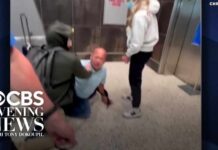

A 50-second video shows a federal immigration agent pointing a handgun at a woman sitting in her car in a Falls Church parking lot, and the clip leaves almost no one neutral.
Story Snapshot
- Video shows an agent pointing a gun at a driver during a brief stop.
- The woman denies trying to hit agents and says the move was uncalled for.
- Reports say the footage does not show her using the car as a weapon.
- Agents let her drive away after the standoff ended in under a minute.
What The Video Shows And Why It Landed Like A Thunderclap
Dash-cam and cellphone clips from Falls Church capture a federal immigration agent stepping out with a gun drawn and aimed toward a woman behind the wheel. She yells that he is pointing a gun in her face. The agent gives commands. The standoff lasts under a minute. The agents do not arrest her. She drives away. Local and national outlets aired the footage and confirmed those core details from what the clips reveal on screen.
The woman, Carolina Molina, said she had been handing out business cards for immigration legal services when she saw agents detaining two men. She recorded as agents approached her car. She denied driving at them and described the gun draw as frightening and needless. News accounts quote her saying she felt scared and targeted as a citizen who spoke up. Reporters noted that her shared clips begin after earlier moments the agents cite as threatening.
What The Government Says And What The Clips Do Not Confirm
The Department of Homeland Security said Molina used her vehicle to try to harm officers and drove in circles. That is a serious claim because a car can be a deadly weapon. The shared video does not show her trying to hit anyone. The New York Times reported the clips show no clear effort to endanger the agents, and other outlets said the footage does not back the vehicle assault claim. The missing prelude remains the key factual gap.
Use-of-force rules hinge on what officers reasonably believe in the moment. If they thought the car could strike them, policy may allow a drawn firearm. If the driver was stationary and not advancing, a gun at the window looks like escalation. Those are not small differences. They decide whether this was sound officer safety or an overreach that chills public trust. The public evidence so far cannot close that gap by itself.
How This Fits A Wider Pattern Of Vehicle Standoffs And Viral Clips
Short, intense videos often drive the national debate on policing and immigration enforcement. The clip is vivid: a masked agent, a drawn gun, a driver in a seatbelt. The parts that are not on camera become the battleground. Agencies point to unseen hazard. Civilians point to what viewers can see. That push and pull repeats across many traffic and parking lot encounters because cars can shift from tool to threat in a second.
Federal immigration authorities are threatening possible criminal charges against a Virginia motorist after an ICE agent was recorded pointing a handgun through her car window—but publicly released video does not show the alleged vehicle attack that the Department of Homeland…
— Common Sense with Chad Law (@chadparkerlaw) August 13, 2026
Conservatives value law, order, and respect for the badge. They also expect power to be used with restraint and clarity. The standards must be even and predictable. If agents faced a real threat, the agency should show it with records, reports, and any still-untapped video. If not, leadership should own the mistake and recalibrate training. Equal justice means defending good officers from unfair attacks and holding bad tactics to account, with facts, not spin.
What Would Resolve The Dispute Without Guesswork
Several items could settle what happened before the gun came out. First, full, unedited dash-cam files with metadata. Second, fixed-camera footage from nearby businesses that shows vehicle paths. Third, dispatch logs and radio traffic that note any attempted vehicle assault in real time. Fourth, sworn statements from the involved agents explaining the perceived threat and commands given. These materials exist or can be requested. They should not be hard to verify if the record is solid.
Policy clarity also matters after the facts are set. Immigration and Customs Enforcement and the Department of Homeland Security should state when agents may draw on a driver in a parking lot and what alternatives they must try first. Clear rules protect agents and the public. They also reduce the odds of a shaky split-second choice. A simple rule helps: if you point a gun, there should be a paper trail that shows why, anchored in objective evidence.
Bottom Line: Show The Receipts, Then Set The Standard
The video makes one thing undeniable: a federal officer pointed a gun at a woman in her car and then let her go less than a minute later. That image will shape public trust more than any press line. The fastest path to fairness is sunlight. Produce the records, fill the missing minutes, and let the chips fall where the facts land. Safety and liberty both depend on that kind of honest accounting.
Until then, viewers will judge by what they can see. And the country will wait for proof of what no one can see yet.
Sources:
mediaite.com, youtube.com, independent.co.uk
© targetliberty.org 2026. All rights reserved.