

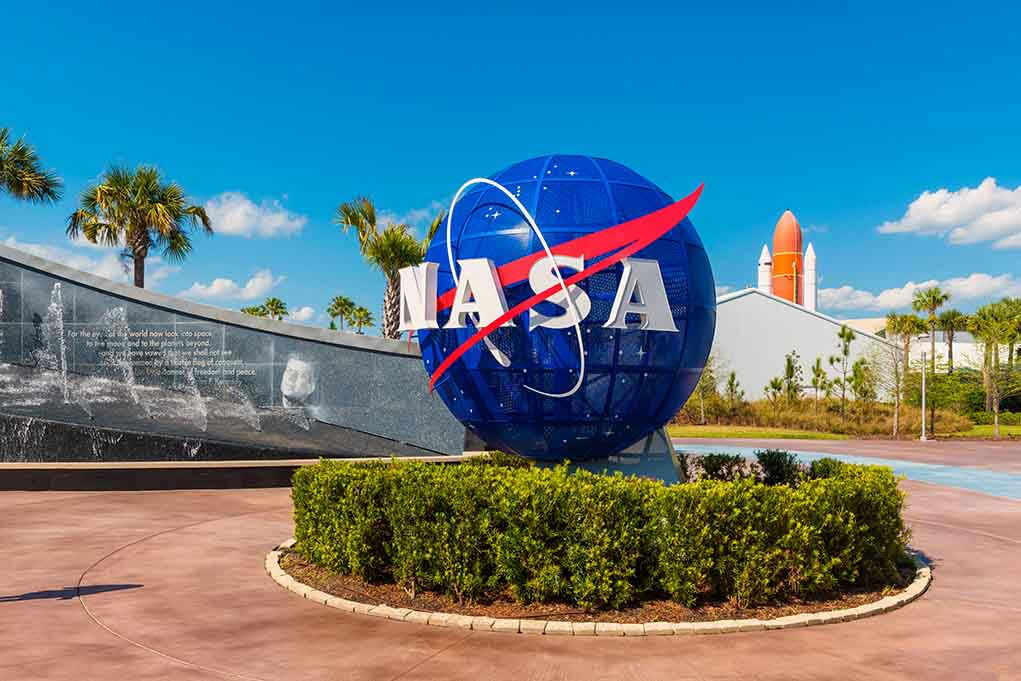
Four astronauts just arrived at Kennedy Space Center to fly closer to the moon than any human in over half a century, testing whether NASA’s most powerful rocket can actually keep them alive in deep space.
Story Snapshot
- NASA’s Artemis II mission launches April 1, 2026, carrying the first crew beyond Earth orbit since 1972
- The 10-day lunar flyby serves as a critical test of life support and spacecraft systems before attempting moon landings
- Four astronauts—including the first Canadian to venture to deep space—will validate the Space Launch System rocket and Orion capsule
- Mission success opens the pathway for Artemis III lunar landing and eventual Mars exploration
Fifty-Four Years Is a Long Time to Wait
The last time humans ventured beyond low Earth orbit, Richard Nixon occupied the White House and gas cost 36 cents per gallon. Apollo 17 splashed down in December 1972, and since then, every astronaut has remained tethered to Earth’s immediate vicinity. Commander Reid Wiseman, pilot Victor Glover, mission specialists Christina Koch and Jeremy Hansen arrived at Kennedy Space Center on March 27, 2026, ready to shatter that five-decade boundary. Their mission differs fundamentally from Apollo—this crew won’t land on the moon. They’ll fly around it, testing whether NASA’s next-generation hardware can sustain human life in an environment where a single equipment failure means certain death.
When Your Spacecraft Needs a Test Drive Before the Real Journey
The Space Launch System rocket and Orion spacecraft represent the most sophisticated deep-space vehicles NASA has ever constructed, but sophistication means nothing without validation. The 10-day mission profile pushes every critical system through real-world conditions—radiation exposure, thermal extremes, life support endurance, and navigation precision. NASA learned hard lessons from rushing Apollo 1, which killed three astronauts during a ground test. The phased approach makes sense: prove the hardware works on a flyby before committing crew to a lunar landing. The rocket rolled to Launch Complex 39B on March 19, the same historic pad that launched Apollo missions and Space Shuttles, now supporting a vehicle capable of generating 8.8 million pounds of thrust.
International Collaboration Actually Means Something This Time
Jeremy Hansen’s inclusion as a Canadian Space Agency astronaut isn’t symbolic window dressing. Canada contributed the Canadarm robotic systems that became indispensable on the Space Shuttle and International Space Station. Their continued partnership in Artemis reflects a practical reality—deep-space exploration requires resources, expertise, and financial commitment beyond any single nation’s capacity. NASA Administrator Jared Isaacman and CSA President Lisa Campbell both attended the crew arrival event, signaling governmental commitment at the highest levels. The mission launches with a two-hour window beginning at 6:24 p.m. EDT on April 1, with backup opportunities extending through April 6 and a secondary date of April 30 if technical or weather issues intervene.
The Real Goal Isn’t the Moon
Artemis II serves as infrastructure validation for NASA’s “Moon to Mars” architecture. The moon functions as a proving ground—close enough for emergency abort scenarios, far enough to test deep-space systems under genuine conditions. Life support must function flawlessly. Radiation shielding must protect against cosmic rays and solar particle events. Navigation systems must maintain precision across 248,655 miles, the distance Apollo 13 achieved as the farthest humans have traveled from Earth. Communication delays, thermal management, and crew health monitoring all require verification before committing to Mars missions measuring hundreds of millions of miles. The Orion spacecraft carries advanced environmental controls, upgraded computers, and redundant safety systems that dwarf Apollo-era technology.
Why This Matters Beyond Space Enthusiasts
The mission validates whether American aerospace engineering can still accomplish what it promises. NASA’s original Artemis timeline projected launches in 2020-2024. Reality delivered 2026. Cost overruns and schedule delays plague major government programs, but the question remains whether the final product works as advertised. Artemis II either proves the Space Launch System and Orion can reliably transport humans beyond Earth orbit, or it exposes critical flaws requiring redesign. The crew’s safe return directly determines whether Artemis III attempts a lunar landing. Beyond immediate mission objectives, success reinvigorates American technological leadership and inspires the next generation toward STEM fields—outcomes with economic and strategic implications extending far beyond space exploration itself.
Meet the Artemis crew in NASA's first astronaut mission to the moon in more than a half-century https://t.co/ZljXf5R2JH
— CityNews Toronto (@CityNewsTO) March 28, 2026
Four astronauts stand ready at Kennedy Space Center, backed by decades of engineering development and billions in taxpayer investment. The countdown to April 1 measures more than days—it measures whether NASA’s ambitious return to deep-space exploration succeeds or becomes another expensive lesson in governmental overreach. Either way, we’ll know soon enough.
Sources:
NASA Sets Coverage for Artemis II Moon Mission
The Planetary Society: Artemis II What to Expect