
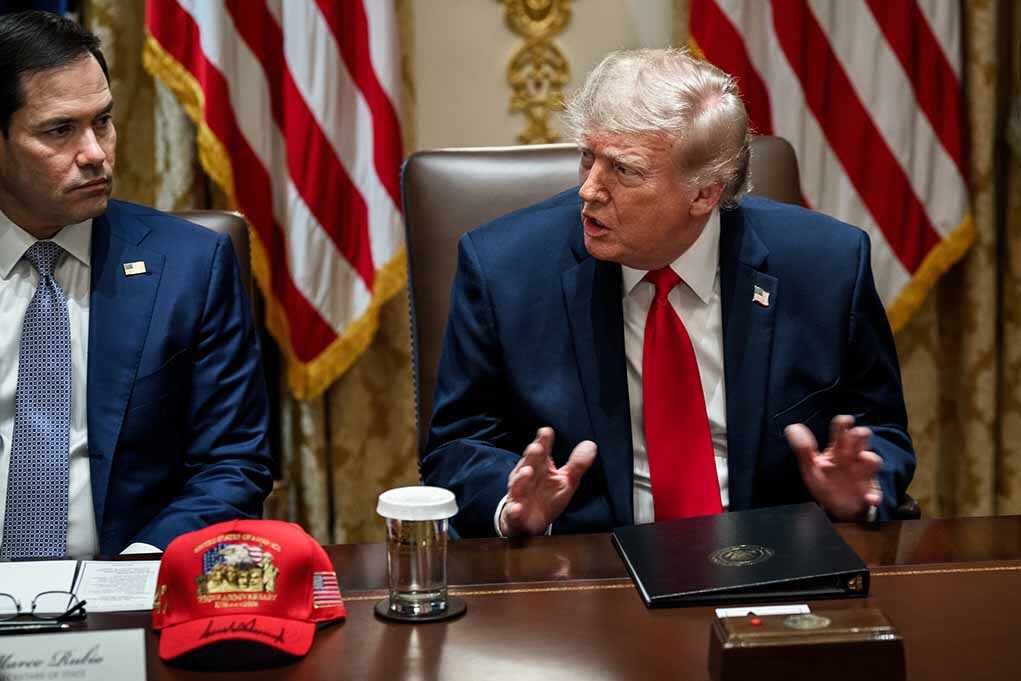
President Trump signed a commission making Secretary of State Marco Rubio his permanent national security adviser, putting one man in charge of both jobs for the first time since Henry Kissinger held the same dual role in the 1970s.
Quick Take
- Trump signed a commission formalizing Rubio as national security adviser, according to White House and administration officials.
- Rubio had already been filling the role in an acting capacity since May 2025, after Mike Waltz left the post.
- The announcement came during Trump’s trip to New York for the United Nations General Assembly.
- Rubio becomes only the second person in American history, after Kissinger, to hold both jobs at once.
What Trump Actually Signed
White House and State Department officials confirmed to multiple news outlets on September 22 that President Trump signed a formal commission naming Rubio the national security adviser on a permanent basis. Fox News Digital reported that a White House official, a senior State Department official, and a senior administration official all verified the move independently. The White House did not release the commission text itself, but the confirmation from three separate officials leaves little doubt about what happened.
Rubio was not new to the job. He had already been running the National Security Council since May 2025, when Trump tapped him to temporarily fill in after Mike Waltz departed the post. That means Tuesday’s signing turned a 16-month stretch of acting duty into a permanent title, rather than launching Rubio into unfamiliar territory.
A Role Reserved for One Other Man
Rubio now joins an extremely short list. Henry Kissinger served as both secretary of state and national security adviser under Presidents Richard Nixon and Gerald Ford from 1973 to 1975, a stretch remembered for centralized foreign policy control and, eventually, congressional pushback over one man wearing two hats. USA Today, The Hill, and the Associated Press all drew the same historical comparison when reporting Rubio’s appointment.
Kissinger’s arrangement did not last without friction. Growing concern in Congress and among the public over the concentration of power eventually pushed Kissinger to give up the national security adviser title in late 1975, even as he stayed on as secretary of state. That history gives Rubio’s dual role real weight beyond a simple staffing update, since it carries a precedent of both effectiveness and eventual institutional pushback.
Why Trump Made It Permanent Now
The timing lines up with Trump’s trip to New York for the United Nations General Assembly, a high-profile setting for foreign policy announcements. USA Today reported the appointment came during that trip, putting Rubio’s expanded authority on display just as Trump was engaging with world leaders on issues ranging from Iran to broader Middle East diplomacy.
The White House has not announced a separate person to take over national security duties, which confirms Rubio is keeping both titles rather than handing one off. The Washington Examiner reported that officials did not clarify exactly when Trump put his signature on the commission, though the confirmation itself was not in question. One brief caveat applies here: the precise date of signing varies slightly across reports, even though the underlying fact of the appointment does not.
What This Means for How Washington Runs Foreign Policy
Consolidating both jobs under one person gives Trump a single point of contact for foreign policy, cutting out layers of bureaucracy that can slow decisions during fast-moving crises. Supporters of the move argue that speed and message discipline matter more than ever given ongoing tensions with Iran and other flashpoints. Critics, going back to the Kissinger era, worry that stacking both roles on one official weakens the checks that come from separate voices inside the process.
Rubio’s rise from senator and 2016 primary rival to Trump’s most trusted foreign policy hand has been well documented, and this appointment cements that trajectory in the clearest way possible. Whether the arrangement proves as durable as Kissinger’s brief run or draws similar scrutiny over time will depend on how Rubio manages the workload most administrations have split between two people.
After formally receiving the appointment letter signed by President Trump, Rubio has become the first person since Kissinger to simultaneously hold the two key positions of Secretary of State and National Security Advisor. Does this signify the dawn of a new era?
— jeff lee (@Jefflee8084Lee) September 23, 2026
For now, the facts are straightforward. Trump signed the paperwork, Rubio keeps both jobs, and Washington has its second Kissinger-style arrangement in fifty years.
Sources:
pjmedia.com, usatoday.com, foxnews.com, apnews.com
© targetliberty.org 2026. All rights reserved.