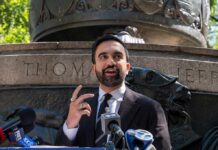

Federal Communications Commission Chair Brendan Carr did something rare for a regulator: he tried to prove his legal case with a brutal highlight reel of daytime TV.
Story Snapshot
- Brendan Carr posted a montage of “The View” hosts urging viewers to back Democrats, while the show seeks special treatment as “news.”
- The Federal Communications Commission (FCC) is already investigating whether “The View” broke equal-time rules with a Democratic Senate candidate interview.
- Disney and ABC insist the show is a bona fide news program, which would shield it from equal-time requirements.
- The fight could redraw the line between opinion TV and news — and how much open campaigning broadcasters can push without giving equal access.
The investigation that put a daytime talk show under a legal microscope
The current battle started when “The View” hosted James Talarico, a Democrat running for the United States Senate in Texas. Federal law says that if a station lets a legally qualified candidate “use” its airwaves, it must offer equal time to rivals, unless the appearance fits narrow news exceptions. Reuters reported that the FCC opened an inquiry in February 2026 into whether the show broke those equal-time rules after that interview. Carr later said the agency was exploring “enforcement action” based on the episode.
This was not a one-off complaint. Media law guidance notes that the equal-time rule has grown more complex as candidates flock to talk shows and friendly platforms instead of traditional straight news. The law carves out space for bona fide news programs and news interviews, but puts the burden on broadcasters to show they are making good faith news judgments, not running partisan infomercials. That grey area is exactly where Carr has placed “The View,” and he has signaled he is willing to test how far the FCC can go in policing it.
Disney’s claim: “The View” is news, not a campaign rally
ABC and its parent company Disney responded by leaning hard on history. Two decades ago, the FCC treated “The View” as a news program for equal-time purposes, and ABC now wants regulators to reaffirm that decision. In filings described by The New York Times and The Washington Post, Disney argued that the show qualifies as a “bona fide news program” and therefore falls under the legal exemption. The company says its booking decisions are based on newsworthiness, not partisan favoritism, and warns that second-guessing those choices would chill its First Amendment speech rights.
Disney’s legal theory matters beyond daytime television. If the FCC agrees that “The View” and similar shows are news, broadcasters keep wide freedom to put candidates on air when and how they want. They can call it commentary or conversation, and they do not have to hand equal time to every challenger who asks. That model has helped build the modern ecosystem of opinion-heavy shows that mix interviews, jokes, and political advice. Disney argues that treating those programs like paid campaign time would make booking candidates risky and expensive, especially in a long election cycle.
Brendan Carr’s montage: using “The View’s” own words as evidence
Carr’s new tactic came when Disney doubled down on its “bona fide news” claim. In response, he posted a video montage to social media, stitched from episodes where hosts on “The View” praised Democrats, attacked Republicans, and urged viewers to vote for Democrat candidates in November. In his post, Carr wrote that Disney says the show is news and that its decisions are based on newsworthiness, not partisan purposes, and he argued that the montage raises serious questions about that claim.
"Disney is arguing to FCC that The View is a “bona fide news program” Disney claims that its decisions are based on “newsworthiness”—rather than partisan purposes—and thus exempt from political equal time rules. Here’s some of the show" Brendan Carr https://t.co/AS4Hii4D6i
— Joy-full425 (@Joyfull425) August 1, 2026
The montage frames “The View” not as a news show that interviews various sides, but as a platform whose hosts repeatedly push one party’s line. From a conservative, common-sense viewpoint, Carr’s point is straightforward: if a show spends segment after segment telling viewers to support Democrats, it looks more like political advocacy than neutral news reporting. When such a program also gives airtime to a Democrat candidate, denying rivals equal time begins to resemble a government-licensed broadcaster stacking the deck in an election.
The equal-time rule, free speech, and what comes next
The equal-time rule sits inside the Communications Act of 1934. It calls for candidates to have equal access to the public airwaves when a station lets one candidate use them. Over time, courts and the FCC carved out exceptions for documentaries, breaking news, and bona fide news interviews so that stations could cover campaigns without turning every story into a math exercise. Media law summaries note that syndicated talk and news shows are reviewed case by case, especially when they blur the line between journalism and entertainment.
ABC and press freedom advocates argue that Carr’s approach crosses a constitutional line by letting government officials judge which viewpoints are too partisan. From a conservative perspective, the key question is narrower: are broadcasters who enjoy special access to public airwaves obeying basic fairness rules when they host candidates? Carr has said the FCC will base its decision on “all relevant evidence and precedents,” including how “The View” actually behaves on air. Whatever the outcome, the fight will shape how far opinion shows can go in openly campaigning before they must offer equal time to the other side.
Sources:
thegatewaypundit.com, apnews.com, nytimes.com, washingtonpost.com, people.com, deadline.com, reddit.com, en.wikipedia.org, rcfp.org, latimes.com, poynter.org, yahoo.com, britannica.com, pbs.org
© targetliberty.org 2026. All rights reserved.