

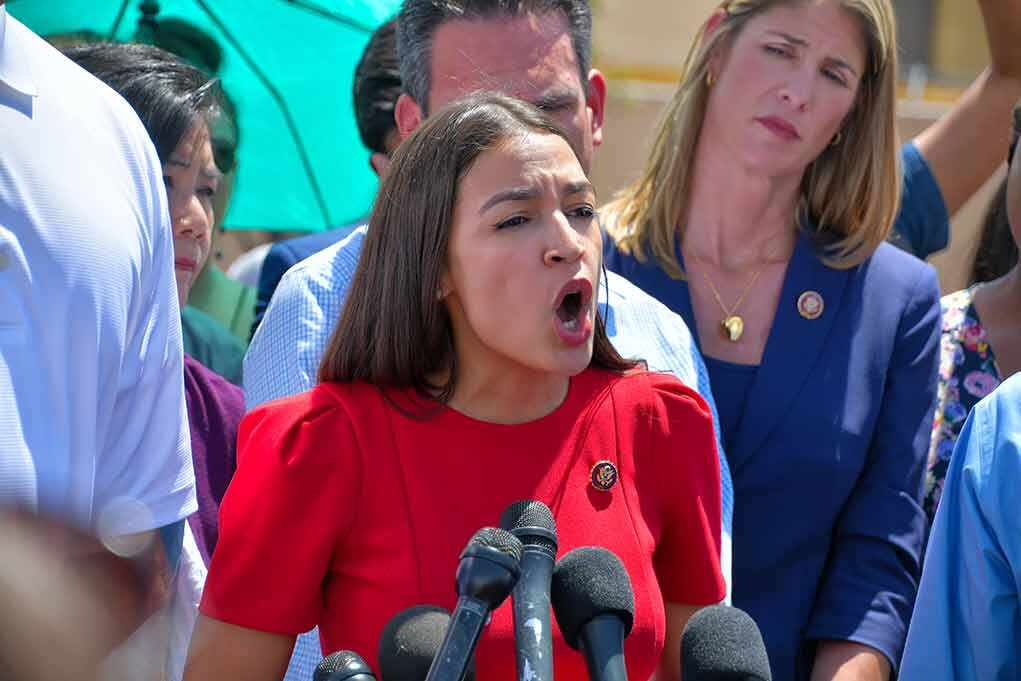
The loudest punchline of the week was not a joke but a switch in AOC’s voice that set off a national argument about politics, identity, and trust.
Story Snapshot
- Conservatives mocked Alexandria Ocasio-Cortez for shifting her delivery at an Idaho rally and in past New York remarks.
- Critics said she adopted a “new accent” or “Southern twang” before predominantly Black audiences.
- Ocasio-Cortez countered that she was code-switching, not faking an accent.
- Linguists and several outlets framed the flap as a common misunderstanding about speech in different settings.
What Sparked The Latest Mockery
Video from a Nampa, Idaho rally showed Ocasio-Cortez shifting her tone mid-speech, which conservative outlets clipped and ridiculed. Fox News described social media blowback and accused her of “debuting another strange accent,” tying it to a broader pattern they see in her public remarks. The Sun added that Republicans called the shift “theatrical” at the Ford Idaho Center and said she was catering to the crowd size and mood. The footage’s viral spread ensured the voice, not the message, took center stage.
These clips reopened an older wound. During a New York speech at Rev. Al Sharpton’s National Action Network, right-leaning outlets said she rolled out a “Southern drawl” or a “blaccent” before a mostly Black audience. The New York Post captured the key charge from conservative Twitter users: she exaggerated her accent on purpose to connect with that room. The pattern claim, not the single clip, drives the current mockery. It suggests a habit, not a moment, which is why the story keeps sticking.
AOC’s Response And The Linguist’s Counter
Ocasio-Cortez did not dodge. She said her voice reflects where she is from and who she is with. She called it code-switching—the normal shift that many people make between home, work, church, and stage. Newsweek quoted her lesson on the topic after Donald Trump Jr. and others piled on, placing her Bronx roots at the center of her defense. The Atlantic’s analysis backed her up and rejected the “verbal blackface” label as a false and loaded charge, noting the behavior fits known patterns of code-switching.
That framing matters because it gives a name, a map, and a neutral model for what many people do. It also checks a moral leap. Accusing “performance” demands evidence of intent; pointing to code-switching points to context. The conservative critique leans on what the ear hears and what the eye sees on a stage. The scholarly reply leans on how people talk in the real world across settings. Those are very different standards of proof and judgment.
Where The Evidence Is Thin And Where It Is Strong
Claims that she faked an accent rely on clips and crowd reaction. They do not cite acoustic studies, spectrograms, or named forensic linguists who measured vowel shifts and pitch against a Bronx baseline. They also mix charges—“Southern twang” one day and “blaccent” the next—without defining the difference or proving either beyond doubt. That soft underbelly gives her defenders easy ground: if you cannot quantify the change, you have not proved deceit.
Her side, however, also leans on narrative more than lab work. The code-switching case stands on her own words and on general linguistic commentary. It offers no published acoustic comparison across speeches, settings, and moods to show the shifts fit a normal range. The playing field is uneven but not by much—both sides trade on impressions. The point of advantage tilts to her because her claim aligns with known behavior and avoids a heavy accusation that lacks proof.
How Voters Hear This, And What Actually Matters
Voters judge tone as much as text. A shift that sounds at home in the Bronx may clang in Idaho. A bounce that wins cheers in New York may look put-on elsewhere. Conservative media know this and punch the bruise every time the clip fits the frame of “pandering”. Yet moral language like “verbal blackface” muddies the water and weakens the case unless facts meet a high bar. Common sense says prove deception or drop the charge.
Two tests would close the loop fast. First, a neutral acoustic analysis that charts her vowels, pitch, and rhythm across events and settings. Second, a steady baseline from long-form unscripted talk at home and at work. If the Idaho spike sits far outside normal range, critics gain ground. If it sits inside the range of code-switching, this story returns to the pile of politics-by-gotcha. Until then, this is more about how we listen than how she speaks.
Sources:
redstate.com, foxnews.com, the-independent.com, nypost.com, newsweek.com, the-sun.com
© targetliberty.org 2026. All rights reserved.