

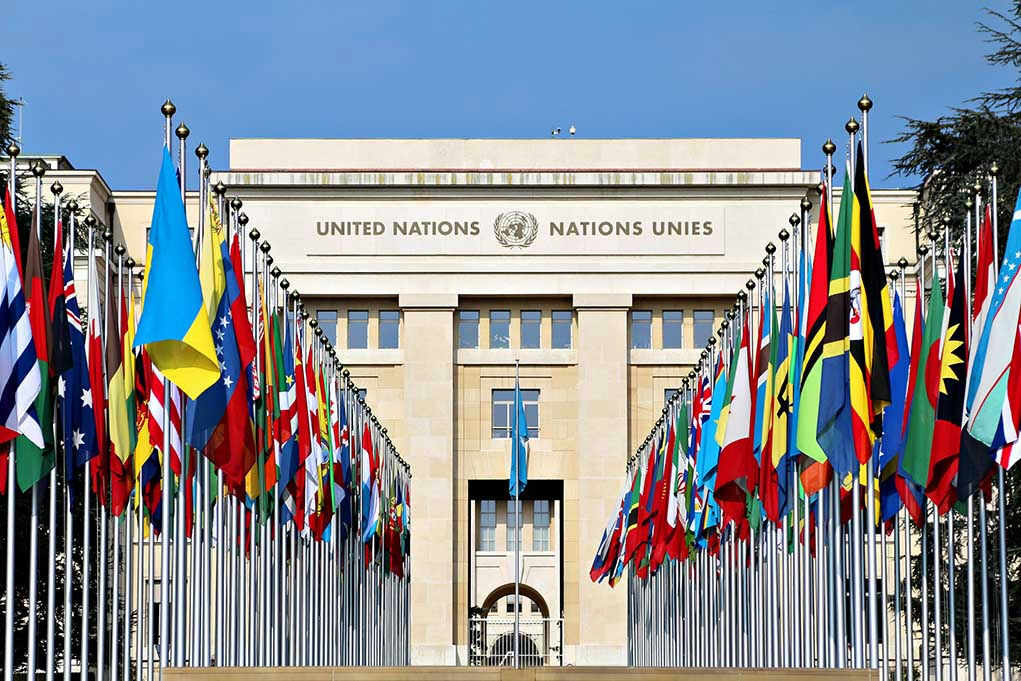
When wartime arguments migrate from court filings and military briefings to the UN podium and a city mayor’s press room, the dispute stops being only about facts on the ground and becomes a fight over who gets to define intent, legitimacy, and communal safety; the Netanyahu–Mamdani clash is a textbook case of that collision.
At a Glance
- Netanyahu used his UN address to argue Israel “prevented genocide,” centering Hamas’s human-shield tactics and Israel’s warning and aid measures as proof of intent and conduct.
- New York City Mayor Zohran Mamdani countered that the speech was a set of “baseless lies” that sanitize a genocide, invoking an ICC warrant and Gaza’s civilian toll.
- The exchange unfolded amid walkouts and protests, underscoring how law, diplomacy, media, and local politics now co-produce the narrative of modern wars.
- Independent institutions are split: a UN Commission of Inquiry accused Israel of genocide, while legal analysts argue the bar for genocidal intent remains contested.
What Netanyahu argued from the UN stage—and why it resonated with his audience
From the dais, Netanyahu’s core claim was concise and absolute: Israel did not commit genocide; it prevented one. The scaffolding for that claim had three beams. First, he centered the October 7, 2023 Hamas massacre as the precipitating atrocity and a continuing threat environment—“the worst slaughter of Jews since the Holocaust”—to anchor Israeli operations in necessity and self-defense. Second, he described Hamas as embedding military infrastructure within civilian spaces—hospitals, schools, mosques—reiterating the law-of-war concept of human shields that shifts legal and moral responsibility for civilian risk toward the shielding party. Third, he asserted systematic civilian risk-mitigation and relief: “millions” of individualized warnings and large-scale aid deliveries, including food tonnage and vaccination campaigns, as behavioral evidence that extermination was not the aim.
He buttressed that narrative by citing a prominent urban-warfare analyst, Col. John Spencer, to claim Israel’s measures exceeded historical precedent in minimizing civilian harm. In rhetorical structure, this is a classic intent-and-conduct defense: if a belligerent warns civilians at scale, prosecutes targets embedded in unlawfully shielded sites, and facilitates humanitarian flows, then genocide—the crime defined by specific intent to destroy a protected group—makes neither legal nor common-sense sense. The hall’s reaction, including conspicuous walkouts, ensured the argument arrived in a hostile soundscape, but that does not alter the logic he presented; it changes how it was received.
How Mamdani framed the countercase—and where its force lies
Mamdani’s rebuttal dispensed with the operational particulars and went straight to the charge: Netanyahu’s address recycled “baseless lies” to sanitize a genocide of Palestinians. Two levers give that position public force. First is the symbolic weight of international criminal law—the reference to an ICC arrest warrant alleging war crimes and crimes against humanity signals that scrutiny has already breached elite legal thresholds, regardless of adjudication timelines. Second is the civilian toll in Gaza and the spectacle of shattered infrastructure; opponents of Israel’s campaign argue that scale and pattern reveal intent, not mere collateral effect, and they foreground incidents in so-called safe zones to press that claim.
His move is strategic: don’t litigate whether “millions” of warnings were sent or how Hamas deploys assets; insist that the outcome—the human catastrophe—speaks louder than asserted precautions. In public persuasion terms, that is potent, particularly when paired with institutional language from UN mechanisms and rights groups that already framed Gaza in genocidal terms in 2025–2026 reporting cycles.
The evidentiary split: intent in law versus conduct in practice
Genocide is not an adjectives war; it is a legal term of art requiring proof of specific intent to destroy, in whole or in part, a protected group. That is why both sides talk past each other. Netanyahu argues from conduct that tends to negate genocidal purpose—warnings, corridors, aid—plus the presence of an enemy embedding within civilian life. His critics argue from outcome scale, leader statements, and patterns of destruction that, taken together, imply a destructive purpose irrespective of claim of precautions. The UN’s Independent Commission of Inquiry concluded in 2025 that Israel committed genocide, citing leader rhetoric among indicia of intent; other legal analyses maintain that, even amid grave violations, the evidentiary bar for specific intent remains unmet under the Convention.
On the facts adduced in the UN speech, the weakest link is verification. Netanyahu’s numbers—“millions” of warnings, “2 million tons” of food, “a million” polio vaccines—are mechanistic claims that can be audited with logs, manifests, and distribution records. The primary reports here reproduce the assertions but do not supply independent validation in-line; they are therefore rhetorically valuable yet empirically unresolved in this packet. Conversely, genocide as a legal conclusion cannot be inferred solely from devastation; it requires evidence of intent that goes beyond effects. Hence the live split across institutions and analysts—competing inferences drawn from overlapping, but differently weighted, data.
Why the mayoral clash mattered—and to whom
Netanyahu personalized his critique by linking Mamdani to Jewish insecurity in New York, arguing that demonizing Israel emboldens antisemitism and endangers Jews. That was not an evidentiary move; it was a political one, designed to translate a distant war into local stakes. Mamdani answered in kind, insisting that calling out atrocities is not bigotry but accountability. When a national leader characterizes a city mayor as “antisemitic,” and the mayor calls that leader a genocidaire, the audience is no longer just diplomats; it is a municipal public managing inter-communal trust. The walkouts and street protests turned the UN speech from a persuasive brief into an identity referendum, a shift that tends to flatten nuance and reward spectacle over verification.
How to actually test the claims that matter
Strip away the theater and what remains are testable propositions. Civilian-warning scale and effectiveness can be reconstructed from IDF targeting logs, mass-SMS routing records, call metadata, leaflet drop orders, and geotagged evacuation notices, then cross-walked with strike timing. Humanitarian flow can be audited through COGAT gate logs, UN OCHA/WFP convoy manifests, customs weight records, and clinic-level vaccination tallies. Civilian-harm mitigation performance can be compared across conflicts by blinded review of time-to-strike after warnings, abort rates, no-strike list adherence, and battle damage assessments. Those are empirical lanes, not rhetorical ones—and they are exactly where policy-relevant truth is found.
On the legal axis, intent analysis requires a disciplined inventory: leader statements in context and sequence; rules of engagement and command directives; targeting rationales recorded contemporaneously; and any internal legal reviews. A UN commission’s genocide finding carries serious weight in diplomacy. A countervailing body of legal scholarship contesting genocidal intent speaks to the caution courts exercise before attaching the gravest label in international law. Both can be true at once: the public square is decided by rhetoric; the courtroom is decided by records.
Dozens of delegates walked out of the Aassembly hall as Israeli PM Benjamin Netanyahu began his UN General Assembly address. Bibi’s speech came as Israel faced growing criticism from world leaders at this year’s assembly over its genocidal war in Gaza.🇵🇸🇮🇱 pic.twitter.com/0elXwHRd6K https://t.co/VGtTbqeby7
— 惣電通・停波・アホカ・ハングレー@THE LORDS OF THE RINGS 🍉 (@FuckTokyo2021) September 25, 2026
The durable lesson: separate persuasion from proof
The Netanyahu–Mamdani episode endures as a study in how modern conflicts are argued. The Israeli premier advanced a conduct-based defense centered on warning, discrimination, and aid; the New York mayor advanced an intent-based accusation grounded in outcome scale and institutional censure. Each chose the forum that advantages his theory of the case: a UN stage for a sweeping reclaiming of intent, a domestic bully pulpit for moral condemnation. For citizens trying to make sense of it, the discipline is simple: ask which claims rest on auditable records, which rest on legal thresholds for intent, and which are designed to mobilize your identity rather than inform your judgment. That filter does not resolve the war, but it does clarify the argument—and that, in contentious times, is its own kind of civic armor.
Sources:
apnews.com, nytimes.com, politico.com, reuters.com, abc.net.au, time.com, cnn.com, jfeed.com, fortune.com, theguardian.com
© targetliberty.org 2026. All rights reserved.