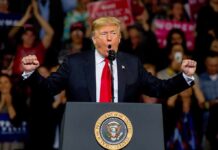
President Trump said the United States will end about $4 billion in annual aid to Israel by the end of 2026, citing a deal with Prime Minister Benjamin Netanyahu and Israel’s stronger economy.
Story Snapshot
- Trump announced a stop to roughly $4 billion in annual aid by year-end 2026.
- He said he and Netanyahu agreed “months ago” to end the payments.
- He argued Israel has grown strong and no longer needs routine aid.
- He said the United States would still help Israel if needed.
What Trump Said, When He Said It, And Why It Matters
Trump made the announcement on November 3, 2026, during a Fox News interview. He said the United States gives Israel about $4 billion a year and that a deal with Netanyahu would end it by the close of 2026. He tied the decision to Israel’s economic rise and said regular payments had become “a wasted thing.” He also said the United States would still help Israel if it faced real need, and that arms purchases could continue on a sale basis.
The dollar figure tracks with long-standing coverage of United States support to Israel, which many outlets round to about $4 billion each year. Recent reporting describes a baseline of $3.8 billion in military assistance per year under a ten-year memorandum of understanding that began in fiscal year 2019. That package includes $3.3 billion in Foreign Military Financing and $500 million each year for joint missile defense programs, both subject to Congress.
How This Fits Inside The U.S.–Israel Funding Framework
United States military aid to Israel has moved through decade-long memoranda of understanding since the late 1990s. The current understanding, signed in 2016, covers fiscal years 2019 through 2028 and outlines a total of $38 billion. Congress still appropriates the money each year, and the understanding shapes, but does not replace, that process. That history makes any shift at the presidential level important, but also shows it must align with how Congress funds programs.
Past transitions show that major changes often happen in stages. The first ten-year understanding phased out United States economic support while preserving military help. That glide path approach suggests one model for reducing routine support while keeping defense cooperation strong. Trump’s statement leaves the door open to future emergency help or arms sales, which could reflect a move from grants to purchases rather than a full break in ties.
What Changes, What Likely Stays, And What To Watch Next
The announced change targets routine annual aid, not all forms of support. Trump said Israel can still buy American weapons and that the United States would help if Israel needs it. That keeps core defense links in place, including training, technology ties, and possible missile defense work, if appropriated. The key question is which line items would stop, and when, given the current ten-year framework and the role of Congress in setting and timing the money.
Oil gave back most of its morning gain on two headlines. Neither changes the war on paper yet.
Brent hit about $100.8 after 14:45 CET and is back near $103.5 (-1.2%) at 16:00 CET.
1. 🛢️ Reuters ties the slide to Trump saying US military aid to Israel will end this year.…
— The Context Desk (@ctxdesk) November 3, 2026
Implementation will hinge on the mechanics. Congress controls appropriations, while the executive branch manages specific transfers and sales. The understanding that runs through 2028 guides expectations but relies on yearly bills. A clean cutoff at the end of 2026 would need either a negotiated change to that understanding, a shift in appropriations, or both. Trump framed the shift as common sense: help allies stand on their own, and spend American dollars where they do the most good.
The Conservative Lens: Strength, Self-Reliance, And Clear Deals
Supporters of a phaseout will see a classic conservative trade: strong alliances built on mutual strength, not permanent subsidies. Israel’s economy and defense industry have grown, and Trump argues that routine grants can give way to fair purchases. That approach keeps deterrence sharp, protects American taxpayers, and respects Israel’s sovereignty. The bottom line is simple: help in a crisis, sell in normal times, and put Congress back in the driver’s seat for big, recurring checks.
Sources:
cbc.ca, ctvnews.ca, huffpost.com, en.globes.co.il, gao.gov, congress.gov
© targetliberty.org 2026. All rights reserved.