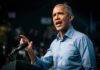

One offhand nickname at a university ceremony turned Joe Biden’s “legacy moment” into a national argument about race, aging, and the price of public mistakes.
Quick Take
- Joe Biden spoke at Syracuse University for a presidential portrait unveiling, then derailed the event with one awkward reference.
- He appeared to call trustee Jeffrey M. Scruggs “Barack,” a remark widely interpreted as confusing him with Barack Obama.
- The clip spread fast online, splitting audiences into “harmless slip” versus “revealing assumption.”
- The episode shows how modern politics punishes ambiguity: intent matters less than what a 10-second clip suggests.
A ceremony meant to honor Biden became a test of how Americans hear a joke
Joe Biden arrived at Syracuse University for a celebratory event: the unveiling of his portrait as the 46th president. These ceremonies usually run on rails—smiles, gratitude, a few stories, then applause. Instead, the room’s energy pivoted when Biden, trying to riff, said he often wanted to turn to “one guy” and ask, “Barack, what are you doing?” He then called the man—trustee Jeffrey M. Scruggs—toward the stage.
The mechanics of the moment explain why it caught fire. Biden’s comment wasn’t delivered as a careful introduction; it landed as a casual aside, the kind of loose talk audiences often forgive in real life. Cameras don’t forgive. Viewers heard a former president apparently tagging a Black trustee with the name of the most famous Black Democratic politician of the last generation. Whether Biden meant it as a resemblance joke or a mental slip, the clip offered critics a ready-made headline.
What Biden actually did on stage, and why the wording mattered
The basic facts are simple: Biden referenced “Barack,” then brought Jeffrey M. Scruggs into the spotlight. The rest is interpretation, and interpretation is where reputations get shredded. If Biden meant, “You look like Obama,” he didn’t say that cleanly. If he meant, “I keep thinking of Obama,” he didn’t clarify that either. The line hung in the air just long enough for the internet to fill the gap with its least charitable version.
Politics at the presidential level runs on precision because the public treats every sentence as evidence. Names carry extra weight. When a public figure blurs one person’s identity into another’s, the audience rarely credits fatigue, nerves, or age. They assume worldview. That’s why a single word—“Barack”—did more damage than a minute of policy talk ever could. It turned a respectful introduction into a cultural Rorschach test.
The viral loop: a 10-second clip beats a 30-minute event every time
Viral moments follow a predictable pattern: isolate, simplify, moralize. The ceremony’s purpose—honoring Biden with a portrait—couldn’t compete with the clip’s emotional charge. Most people never saw the room, the context, or the full exchange. They saw a former president, a Black trustee, and a name that seemed to collapse individuality into stereotype. The internet excels at compressing complicated humans into a single frame, then demanding a verdict.
The reaction split along familiar lines. Critics called the remark inappropriate and argued it reflected racial insensitivity or unconscious bias. Supporters described it as an awkward but harmless attempt at humor, the kind of verbal stumble that happens to anyone, especially under bright lights. Common sense says both camps are responding to something real: language can reveal assumptions, and people also misspeak without malice. The trouble is modern politics rarely allows both to be true at once.
Intent versus impact: the conservative common-sense standard
American conservative values tend to prize fairness, individual dignity, and a skepticism of rush-to-judgment mobs. That standard doesn’t require pretending words don’t matter; it requires matching consequences to evidence. The clip alone cannot prove racism, and accusations that big should demand more than a clumsy line. At the same time, leaders carry a duty to speak clearly about people as individuals, not as stand-ins for a category or a familiar celebrity.
This is where the moment becomes instructive. Biden has spent decades in public life, and public life is a discipline. A disciplined speaker doesn’t gamble with identity-based jokes in a country this tense. When a speaker does gamble, the public doesn’t ask whether he intended harm; they ask why he invited predictable controversy. That’s not “cancel culture.” That’s accountability for judgment, especially from someone who held the highest office.
The quiet damage: how these episodes erode trust in institutions and media
The Syracuse event also shows how institutional moments—universities, boards, civic ceremonies—get flattened into partisan content. Syracuse University hosted a portrait unveiling, a ritual meant to project stability and continuity. The viral aftermath projected the opposite: fragility, missteps, and outrage economics. Older Americans recognize this pattern from years of political theater. The newer twist is speed: the public now processes leadership through clips optimized for anger, not understanding.
The media ecosystem amplifies that speed. Outlets and influencers thrive on the hottest interpretation, not the most careful one, because attention pays. That incentive structure makes it harder for ordinary people to maintain a steady view: mistakes become scandals, scandals become identity tests, and identity tests become tribal warfare. The real loser is civic trust. When a portrait unveiling becomes a race argument within hours, people stop believing public life can be normal.
What this gaffe says about the next phase of American politics
Biden’s “Barack” moment will fade, but the template won’t. America is entering an era when every politician’s off-script humor is a high-risk product. The public wants authenticity, yet punishes authentic mistakes with maximum severity. Politicians respond by speaking like lawyers, which makes them sound fake, which invites more “gotcha” hunting. The cycle feeds itself. The only way out is leadership that values restraint over cleverness and clarity over improvisation.
https://twitter.com/Mermaz/status/2044399568364695874
The lesson for voters over 40 is blunt: treat viral clips as leads, not verdicts. Watch the full exchange if you can. Demand evidence before accepting the loudest label. Then, apply a standard that still makes sense in a sane republic: judge people by patterns, not pounces; by consistent conduct, not one mangled sentence. Biden’s line was careless and avoidable. The internet’s certainty about what it “proved” is its own kind of carelessness.