Trump says he knows exactly what happens to America if Iran kills him — and he made sure Iran knows it too.
Story Snapshot
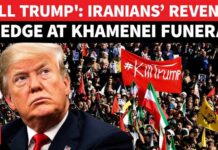
- Mourners at Ayatollah Ali Khamenei’s funeral in Tehran openly chanted “Kill Trump” and displayed banners reading “We will kill you” and “Kill Trump — $100 million bounty.”
- Khamenei was killed in a joint U.S.-Israeli airstrike on February 28, 2026, triggering an active war between Iran and both countries.
- Trump acknowledged he is “number one on Iran’s kill list” and the U.S. Secret Service advised him to swap the Qatar-gifted jet for an older Air Force One as a security precaution.
- Experts note that Iran’s revenge rhetoric — while real and state-tolerated — has historically produced delayed or symbolic retaliation rather than direct assassinations of foreign leaders.
What Happened at Khamenei’s Funeral
Hundreds of thousands of mourners packed the streets of Tehran on July 4, 2026, for the funeral procession of Supreme Leader Ayatollah Ali Khamenei. The crowds carried red flags — a symbol of blood and revenge in Iranian tradition — and unfurled massive banners with explicit threats directed at President Trump. Video from CBS Evening News and Times of India captured the chants clearly. The scene was not spontaneous street anger. It was organized, visible, and broadcast to the world.
🚨 Israel War Room special: Night-time “WE WILL KILL TRUMP” banner drops like clockwork.
This entire narrative? Manufactured by Israel from start to finish.
Fake threats, amplified propaganda, funeral banners turned into global headlines — all to justify more strikes on Iran.… pic.twitter.com/uV6iADifU2
— 💫 Vøɪɗ Ƈσѕмɪc Ƈσммєηтɾу 💫 (@VoidCommentaryX) July 10, 2026
Senior Iranian officials attended the ceremony at the Grand Mosalla mosque, including Parliament Speaker Mohammad-Bagher Ghalibaf and Judiciary Chief Gholam-Hossein Mohseni-Ejei. Delegations from over 90 countries were present, including the prime ministers of Pakistan and Turkey and military chiefs from Saudi Arabia. India sent a deputy foreign minister rather than Prime Minister Narendra Modi — a notable snub that signals Iran’s partial diplomatic isolation despite the large turnout.
How Khamenei Was Killed and What Followed
U.S. and Israeli forces launched a joint airstrike on Khamenei’s fortified compound in downtown Tehran on February 28, 2026. Reuters, the Associated Press, and Israeli Prime Minister Benjamin Netanyahu all confirmed his death. Satellite images showed heavy damage to the compound. Iranian officials released footage of the destruction. The strike also killed several of Khamenei’s family members, including his granddaughter Zahra Mohammadi Golpayegani, whose coffin was displayed alongside his at the funeral.
Iran retaliated with missile and drone strikes on Israeli targets and U.S. military bases in the Gulf. The Pentagon confirmed no American casualties from those retaliatory strikes, though six U.S. service members were killed during the broader conflict. Iran’s President Masoud Pezeshkian called retaliation a national “duty.” The revenge banners at Khamenei’s funeral, including one claiming a $100 million bounty on Trump, fit that public posture — though no official Iranian government document has confirmed the bounty’s authorization or funding.
Trump’s Response and the Secret Service Calculation
Trump did not go quiet. He publicly acknowledged being “number one on Iran’s kill list” and responded with his signature bravado, boasting that the U.S. had “knocked the hell out of Iran” and claimed to have sunk the entire Iranian navy. Whether those claims are precise is a separate debate — but the posture is deliberate. Trump’s message to Tehran was unmistakable: killing him would not end the conflict. It would escalate it in ways Iran cannot afford.
You apparently didn't see the banners at the iranian leaders funeral that said "we will kill trump…"
Youre kind of an idiot . They announced it. And we Americans won't stand for it!— Jeremy Russell (@Jremy2023) July 10, 2026
Behind the scenes, the U.S. Secret Service took the threats seriously enough to act. Agents advised Trump to abandon the Qatar-gifted Boeing 747 during his NATO trip and fly on the older, more secure legacy Air Force One instead. The White House framed the jet switch as “distraction and misdirection” — a classic security tactic that keeps adversaries guessing about the president’s actual location and travel patterns. It is a telling detail. Public bravado and quiet precaution are not contradictions. They are the two tracks of a credible deterrence strategy.
Iran’s Revenge Pattern — Loud Promises, Slow Delivery
History offers important context here. After the U.S. killed General Qasem Soleimani in January 2020, Iran vowed devastating retaliation. What followed was a missile strike on U.S. bases in Iraq that caused traumatic brain injuries but no immediate deaths — significant, but far short of the promised vengeance. After Israel killed Hamas leader Ismail Haniyeh in Tehran in 2024, Iran again promised severe retaliation and again delayed. Experts consistently describe this pattern as strategic signaling — Iran uses revenge rhetoric to maintain domestic unity and regional credibility without triggering a response it cannot survive.
That pattern does not mean the threat to Trump is fake. Iran has a documented global assassination campaign targeting foreign nationals and dissidents. The $100 million figure on those banners, verified or not, reflects a real institutional appetite for revenge. But there is a meaningful difference between a regime that wants Trump dead and a regime with the operational capacity to kill a sitting U.S. president surrounded by the most sophisticated protective apparatus on earth. Iran knows that difference better than anyone. The chants are real. The banners are real. The gap between rhetoric and action has been real too — every single time.
Sources:
facebook.com, aljazeera.com, apnews.com, foxnews.com, reuters.com, youtube.com
© targetliberty.org 2026. All rights reserved.