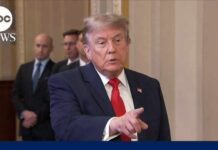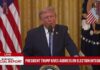

A single walkout and a few reaction shots now risk substituting meme-ready spectacle for substance in our politics—exactly the tradeoff many Americans fear from a media and government culture that treats accountability like a game.
Story Snapshot
- Donald Trump ended a contentious Meet the Press interview with Kristen Welker after pushback, fueling viral clips and memes [2].
- The interview’s confrontational back-and-forth heightened focus on Welker’s facial reactions, which audiences widely circulated [1][2].
- Welker’s stated approach stresses restraint and listening, complicating claims that expressive theatrics drove the virality [3].
- Evidence gaps remain: no verified timestamps or analytics confirm which expressions spread most or why [1][2][3].
What Happened On Air And Why It Went Viral
ABC-affiliated reporting states that Donald Trump walked out of an interview with NBC’s Kristen Welker after a testy exchange, describing him as visibly agitated when challenged on election claims [2]. The clash created a classic viral environment: sharp confrontation, an abrupt ending, and clean reaction shots. Secondary video framing promoted the moment as a rout, further incentivizing users to clip expressions and circulate them as shorthand for the interview’s tension [1]. The result—memes overshadowing substance—mirrors a recurring pattern in modern political coverage.
NBC’s Meet the Press format placed Welker opposite a combative incumbent, producing frequent interruptions, accusations of media bias, and escalating friction that many viewers parsed through nonverbal cues [2]. The more heated the exchange, the more valuable a neutral face becomes to meme culture, because a raised eyebrow or compressed smile can be captioned to imply judgment without words [1]. That dynamic helps explain why screenshots of Welker’s reactions proliferated, despite limited hard proof about which exact frames drove the most engagement.
Claims About “The Face” And The Evidence Gaps
The viral narrative positions Welker’s expressions as “the face that launched a thousand memes,” but the current record lacks clip-level verification: no shared timestamps, platform metrics, or independent content analysis confirm which reactions spread fastest or why [1][2]. The strongest documented facts focus on Trump’s demeanor and exit, not on Welker’s nonverbal behavior [2]. Without frame-by-frame review or analytics, attributing the virality primarily to her expressions remains plausible but unproven. That ambiguity matters when memes drive public impressions more than verified context.
Welker has described her interview philosophy as centered on listening, restraint, and minimal interruption, suggesting a baseline on-air affect closer to controlled than performative [3]. That statement does not disprove that certain reactions resonated online, but it cautions against reading theatrical intent into standard moderator behavior. Selective clipping can isolate neutral listening faces and repackage them as pointed commentary. Until researchers tie specific reaction shots to engagement spikes, the fairest conclusion is that confrontation plus walkout primed audiences to over-read familiar journalistic cues [1][2][3].
Why This Resonates With Broader Public Frustration
Viewers across the political spectrum increasingly suspect that institutions—government and media alike—reward showmanship over problem-solving. A viral interview that devolves into walkout narratives and reaction memes feeds that belief. Conservatives see entrenched media hostility toward America First policies; liberals see a press struggling to hold power to account without becoming part of the spectacle. Both sides see attention hijacked by optics instead of answers on immigration, costs, wars, and trust in elections [2]. This episode reinforces that shared concern.
Americans demand that Donald J.Trump apologize to journalist Kristin Welker for his disgraceful verbal attacks against her yesterday during the NBC Meet the Press interview! Trump should be ashamed of himself for his un-American hate-filled verbal attacks against journalists! pic.twitter.com/GpMZlcG0M6
— Rob (@robbyusea) June 8, 2026
For citizens seeking clarity, three steps would meaningfully improve accountability. First, release a transparent clip registry with timestamps highlighting the most-shared reaction shots, tied to raw video for context. Second, publish platform-level engagement data separating posts focused on Welker’s expressions from those centered on Trump’s exit. Third, encourage outlets to pair viral moments with verified issue explainers. These measures would not end meme culture, but they would reduce the gap between entertainment and evidence [1][2][3].
Sources:
[1] Web – Face That LAUNCHED 1000 Memes! Kristin Welker’s Expressions During …
[2] YouTube – NBC’s Kristen Welker Gets OBLITERATED by Trump in Viral Interview
[3] Web – Trump storms out of testy ‘Meet the Press’ interview with Kristen …
© targetliberty.org 2026. All rights reserved.